
Crate-Diving at Home (7)
Rediscovering Rainbow’s debut album, and more
When I first discovered Deep Purple, it felt to me like an earthquake. Having lived through some actual earthquakes since then, I still think the comparison is apt.
In a previous post, I took a look back at that moment:

I would quickly became a big fan of Deep Purple. One sign of my commitment was that I was genuinely baffled when other people didn’t “get” them.
Real fans (remember, that’s short for “fanatics”) study the objects of their fascination. Purple were the first band I studied — I collected their albums, learned the backstories to their songs, and, along the way, became obsessed with their lead guitarist, Ritchie Blackmore.
Some people just dismissed Purple as too loud and heavy. Ironically, a decade or two earlier, our parents’ generation had used the same words to dismiss Chuck Berry, the Beatles, and the Rolling Stones. So, for rock fans to dismiss Purple (or Led Zeppelin, for that matter) the same way struck me as hypocritical. Of course, different people just have different thresholds for loudness and mayhem, but it took me some time to realize that.
Like most Purple fans, I was attracted to their deeper, more layered compositions. Blackmore and organist Jon Lord were classically trained, and it came through in their writing.
Lord actually composed and produced the first real symphonic rock piece, “Concerto for Group and Orchestra”. Purple performed it with the London Philharmonic, to surprisingly positive reviews from the classical critics.
To me, Purple were next-level musicians who just happened to play loud, heavy music. They were innovative and experimental, and I loved picking apart the songs, playing their albums over and over, listening for little nuances I had missed before. They clearly had one foot in the world of progressive rock, though the term wasn’t widely used yet.
Standing out in their intricate wall of sound, there was always Blackmore. He wove a tapestry of notes with his guitar, intricate and technically demanding, yet always melodic and in harmony with the song.
Just before my freshman year in college, the news landed like a bomb that Blackmore was leaving the band. Purple fans were devastated. We wondered what had happened. In that pre-Internet era, news traveled slowly, rumors took time to form and spread, and there weren’t many places to go for updates on our favorite artists. So no one really offered an explanation.
Still, I found a small article somewhere (it wasn’t Rolling Stone — they didn’t like Purple and rarely covered them) saying that Ritchie Blackmore had formed a new band and was recording an album. I was already frequenting the local record store in Cambridge, so I began checking in several times a week to see if the new record had dropped.
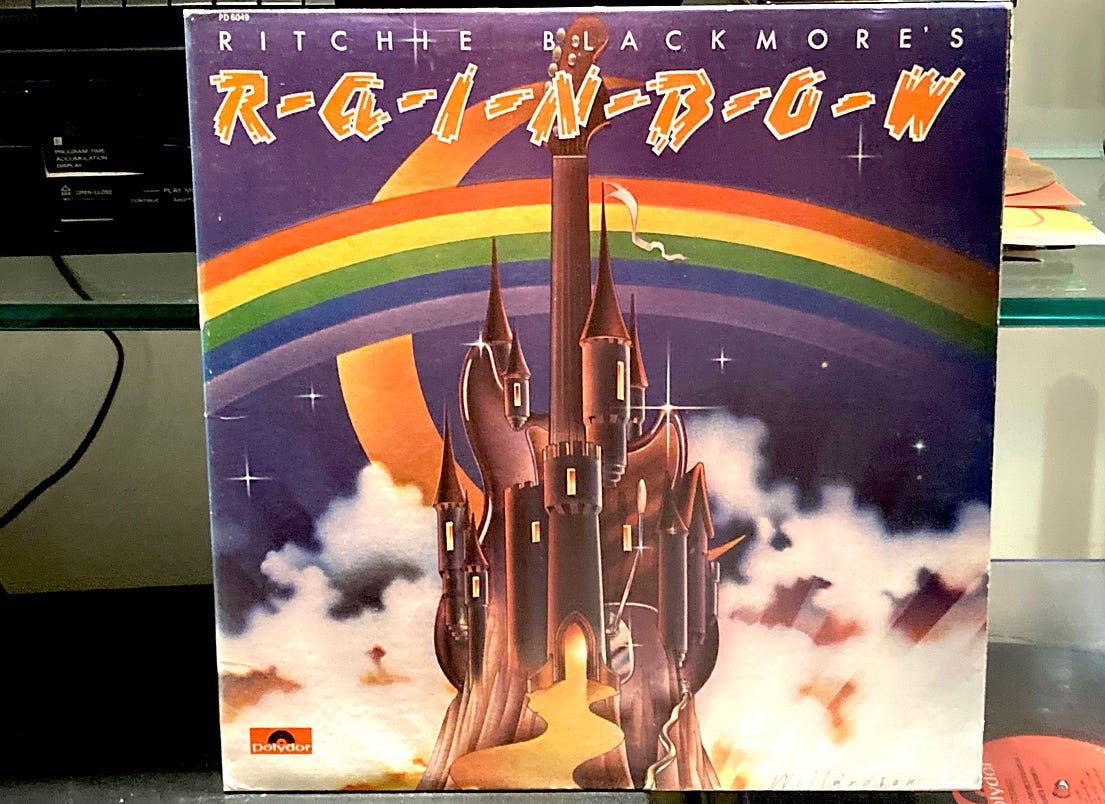
And then one day, I saw the album cover hanging from one of their ceiling exhibits. That meant the store considered it an important release! I went on a mad scramble, initially looking under “B” for Blackmore, and then finding the album under “R” for Rainbow.
I put the album on as soon as I could get back to our dorm room. It didn’t disappoint, though it sounded nothing like Purple.
Rainbow featured a relatively unknown vocalist, Ronnie James Dio. He seemed to have unlimited range and power. His interplay with Blackmore’s guitar made the album an instant classic. And his singing style would become a template for a generation of rock and metal vocalists.
There was a lot more backstory I only learned later. Dio and Blackmore had known each other for many years — Dio’s band, Elf, had been touring as Deep Purple’s opening act. When Blackmore left to found Rainbow, he asked Dio to join him.
After three albums, Dio would join Black Sabbath. By then, he was established as a top rock singer. With Sabbath, he cemented his status in the pantheon of rock’s greatest vocalists.
Ritchie Blackmore continued on with Rainbow, which is now recognized as one of metal’s foundational bands. They lasted several successful years, but then Blackmore grew disillusioned with the metal scene, which he felt was trapped in a spiral of harshness and excess. He quit and went back to his classical roots.
In 1997, he and his wife, Candice Night, founded Blackmore’s Night. They are still touring today, performing mostly acoustic music based on Renaissance-era themes and instruments.
They also perform folk-style arrangements of contemporary pop and rock songs.
Blackmore may have come full circle, but he left behind quite a legacy in the worlds of hard rock, heavy metal, and progressive rock. For me, Rainbow’s debut album is one of the signposts of that legacy.
Interestingly, the album features very little of the high-speed shredding that Blackmore practically invented, and which had made him famous. It is more about composition and harmony.
Here is one of my favorites from the album. The guitar lead intertwines with the vocal line; the solo is restrained and echoes the vocal melody:
They probably knew that Purple fans were hoping for at least one technical extravaganza, and they saved it for last. They chose an old Yardbirds song, “Still I’m Sad,” and rewrote it as an instrumental. The end result was everything I could have hoped for—beautiful, mystical and pyrotechnical:
Here is the full album:
Great essay.
I think I have more Blackmore's Night than Rainbow in my music library. Irrespective of that, it's been far too long since I've listened to either.