
Fleetwood Mac: “Bare Trees”
Crate Digging at Home, Chapter 16
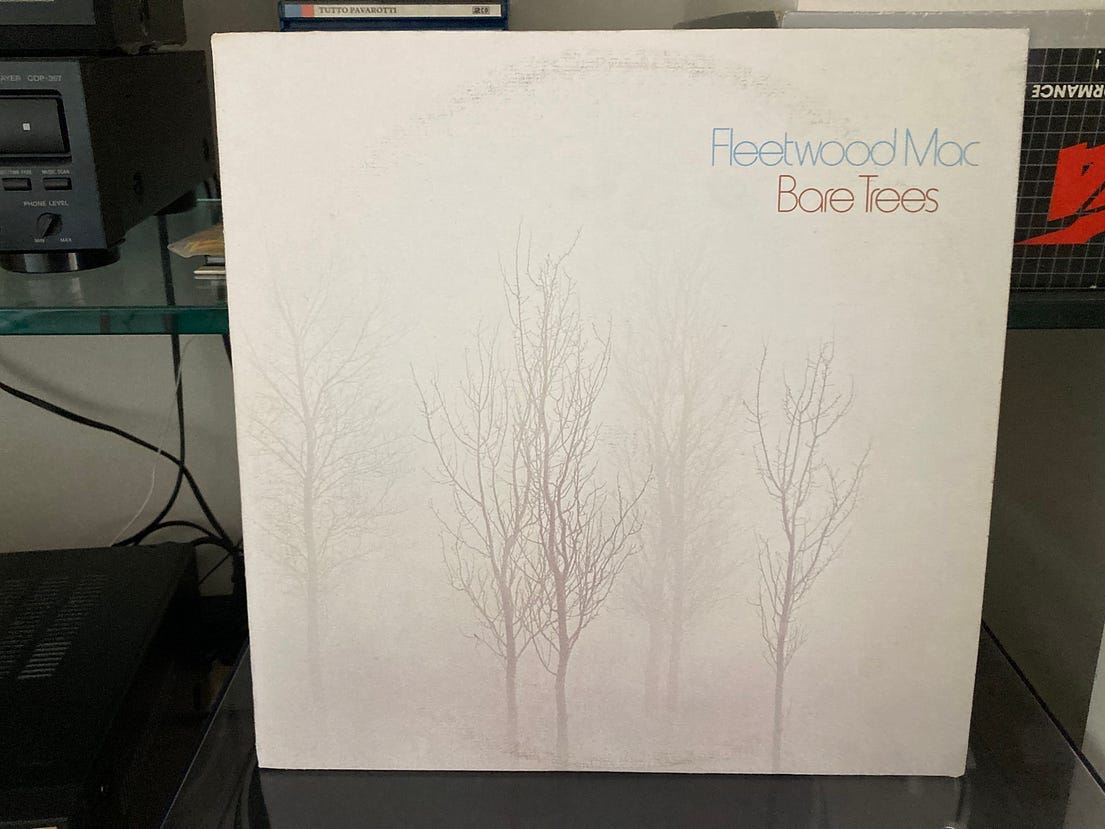
Fleetwood Mac always seemed to be there. They were not quite as big as Jefferson Airplane or the Doors, but they would end up outlasting both. Their sound was softer, more personal, more wistful. After all, they were originally a blues band.
If you want to understand Fleetwood Mac, you need to start with the original band, founded in 1967 by Peter Green, John McVie, and Mick Fleetwood (the band’s name is a mashup of Fleetwood and McVie). All of them came out of the British blues movement, and they were among the inventors of what became blues-rock.
Green is considered by many to be the best of the early generation of British guitarists, even ahead of Eric Clapton. He was called “The Green God” by other musicians. He rarely played fast, preferring instead to choose his notes. He always seemed to choose right — his playing was profoundly expressive.
Santana idolized him and spent his career trying to replicate Green’s sound, with mixed results. Important bit of history: Green wrote Santana’s greatest hit, “Black Magic Woman,” which essentially jump-started Santana’s career.
Green’s own career largely ended after he was maimed by tainted drugs at a party, though he continued on in a small way with the unstinting help of his best friend Nigel Watson. Green would die in 2020, shortly after Watson, who had been his lifeline for years. That is an entire story unto itself.
This is a clip of Green (with the green guitar, of course) and Watson, playing an instrumental version of “Man of the World.” The original version had been an early hit for Fleetwood Mac. Here, Watson takes on some of Green’s original lead lines.
I find it one of the most moving things I’ve seen on YouTube:
Fleetwood Mac had several hits in the late 60’s, and then went through a lot of lineup changes, with McVie and Fleetwood remaining constant. McVie’s wife, Christine, joined the band officially in 1970 (she had started doing studio sessions with them as Christine Perfect before marrying McVie).
Other notable members of the band included Jeremy Spencer (from the early lineup), Danny Kirwan, and Bob Welch. Kirwan wrote a lot of their material, especially after Green left the band.
“Bare Trees” is the last album recorded with Danny Kirwan in the lineup, and it shows off his songwriting at its peak. He wrote five of the songs, while Christine McVie and Bob Welch each contributed two. In retrospect, it all added up to the best songwriting in the band’s history.
The problem is, Kirwan had been developing a serious drinking problem, and eventually had a meltdown. The band was on tour to support “Bare Trees” when he went on a rampage that led to the rest of them asking him to leave. Peter Green and Nigel Watson actually stepped in to play some of their remaining shows.
Fleetwood Mac released three more albums before disintegrating yet again. Mick Fleetwood recruited Lindsay Buckingham and Stevie Nicks to join him and the McVies to restart the band. That’s when they left their blues roots completely behind and became a pop-rock act, marketed largely on the appeal of Nicks’ hair and teeth.
As big as they would become, I personally could never get interested in anything they did from that point on. But at least Fleetwood and the McVies finally got to cash in after decades spent laboring in the mines. I don’t begrudge them that, though many in their original fan base cried “sell-out.”
For me, “Bare Trees” remains the finest album Fleetwood Mac ever made. Christine’s voice is achingly beautiful, in a husky, almost maternal way. The vocal harmonies and the understated guitar work are spectacular. The songwriting is superb. And Danny Kirwan’s “Dust” may be the most beautiful song about death ever recorded by a rock band.
I always loved that album cover. I probably love the album too, but haven't played it in decades. Thanks for the video link - I do love Peter Green. But I'm one of those kooks who love all eras of Fleetwood Mac. Which probably doesn't surprise you.
Keep on excavating! Ready for the next chapter.
I really like this record, and Coulda sworn I had a copy, but no-go.